
What’s Going On With Waterview?
Aug 25, 2026
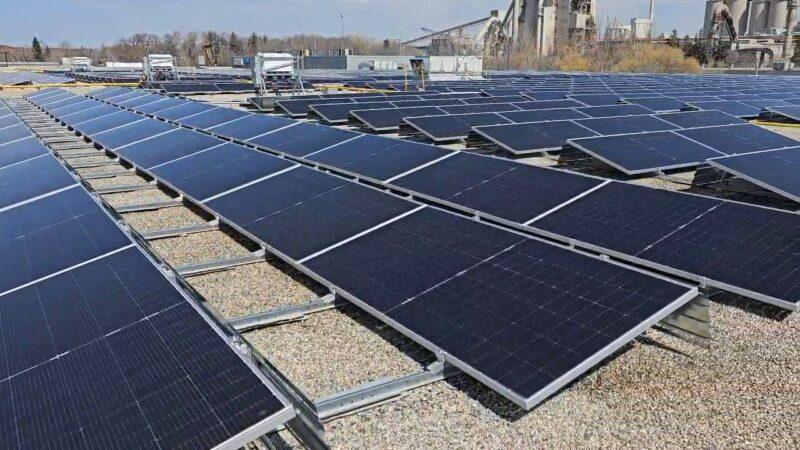
View of the upgraded Waterview Project
When SolarShare was founded in 2010, co-founder Mike Brigham was looking for a sturdy, reliable solar project on which to base the beginnings of SolarShare. He found his answer in amorphous solar panels, developed by the manufacturer, United Solar Ovonics (UniSolar). Their panels were durable, flexible, cheap to make and easy to replace: the perfect panel to inspire trust and confidence in SolarShare for potential new investors. 3,040 of these panels became the Waterview Project: SolarShare’s first large-scale solar project, and the largest community-financed rooftop solar system in North America at the time. From this single project, SolarShare has been able to grow into a 51 project operation, with over $100 million invested.
From 2010 to 2025, the Waterview Project functioned exactly as it should, delivering power to the community through the provincial electricity grid. Then, in May of 2025, the owners of the roof that Waterview Project sits on gave us some bad (but expected) news: we would have to take off the solar panels for a complete roof replacement.
The repair could not have come at a worse time – removing the panels in May meant that the roof was to be bare for the entire summer. This is a problem because summer is the most lucrative time for solar energy production; the sun is brighter, and it stays out for longer than it does in other months.
With the rest of our projects, we have a clause in our lease contract preventing landlords from asking us to remove the panels during the summer months. But since this was our first project, the clause had not yet been incorporated into our standard practice, and we were forced to remove the panels.
Though taking the panels off meant a significant loss of revenue, it also provided an opportunity. Since the Waterview project was installed in 2010, solar panel technology has improved significantly. We realized that instead of reinstalling the old ~3,000 panel system, we could install a new ~450 panel system that would be more optimized and produce much higher revenue.
This optimization is possible by increasing the amount of time our system reaches peak output capacity each day. With the old system, we were rarely able to reach peak output: it only happened for about an hour or 2 per day on particularly sunny summer days. But with the new system, we can stay at peak output from 10AM to 5PM on most clear, sunny, summer days, which is a major improvement. This was achieved by oversizing the system: essentially, instead of having a system that only reaches capacity when every individual solar panel reaches its own producing capacity (which only happens when the sun is at its brightest), we doubled the number of solar panels so that the system operates at capacity even if each individual solar panel is only producing 50% of the electricity it can. Using this method, we can produce the maximum amount of electricity and revenue even when the sun is not at its maximum intensity.
Following the roof repairs, this new optimized solar system was installed at the Waterview site and went online at the end of April, just in time to be fully operational for the key summer months. Since it was installed, the new system has been generating an average of roughly 20,000 kWh of electricity output each week and producing between $10,000 to $15,000 of weekly revenue, which amounts to a revenue increase of $132,000 per year in comparison to the old system.
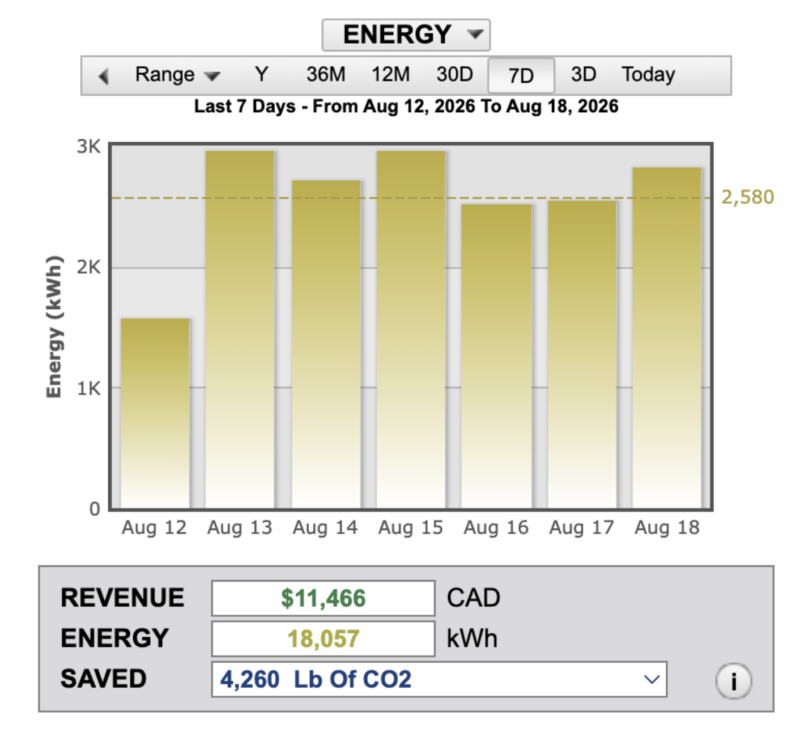
A week’s worth of energy production
As for the old system, it has, for the most part, being recycled. The system elements that were in use contained a lot of valuable building materials, particularly aluminum, so they are being broken down into raw materials to be used in other products. We also had a large amount of backup solar panels in storage that are not compatible with the new system, so they have been donated to Cuba to be used for electricity generation there, where the present need is urgent.
Moving forward, the upgraded Waterview Project will continue to provide SolarShare with increased revenue until the FIT contract ends in 2031. Following this end date, the future of this project is open-ended. We hope and expect that the Waterview project will remain operational long past this date – SolarShare’s board is currently exploring options to make this a reality.
The upgrades to the Waterview Project reflect SolarShare’s overarching mission to continue being trailblazers of community-owned solar energy revolution. In addition to the major Waterview Project upgrade, less splashy, high-impact changes are continuously being made. Recently, we have installed new inverters at three of our sites, vastly improving the efficiency of the systems, and we have been making changes to our operational processes to optimize labour and reduce costs. SolarShare is anything but stagnant: we are always looking for opportunities to reach new heights and expand the possibilities of what solar energy can do in Ontario. New opportunities are always being explored, and we hope to announce more developments in the not-too-distant future. Stay tuned!